History

Millennia of History

From an ancient Roman emperor's retirement palace to a medieval city-state and vibrant modern metropolis — Split's history spans over 2,000 years.
"All images on this website were generated by Gemini."

Overview

2,000 Years in the Making

Split's story begins not as a city but as a private retirement residence — one of the most ambitious building projects of the late Roman Empire. From those imperial origins, it evolved through Byzantine rule, medieval Croatian kingdoms, centuries of Venetian dominance, and the turbulent 20th century into the thriving city it is today.

Few cities in the world can claim such an unbroken thread of continuous habitation within a single set of ancient walls. Split is not a museum — it is a living city that happens to exist inside a Roman palace.
Timeline

Key Periods in Split's History

3rd Century BC
Aspálathos — Greek origins
A Greek colony known as Aspálathos is established on the peninsula, named after the thorny shrub that grows wild along the coast. Trade with the Illyrian tribes of the mainland begins to flourish.
295–305 AD
Diocletian builds his palace
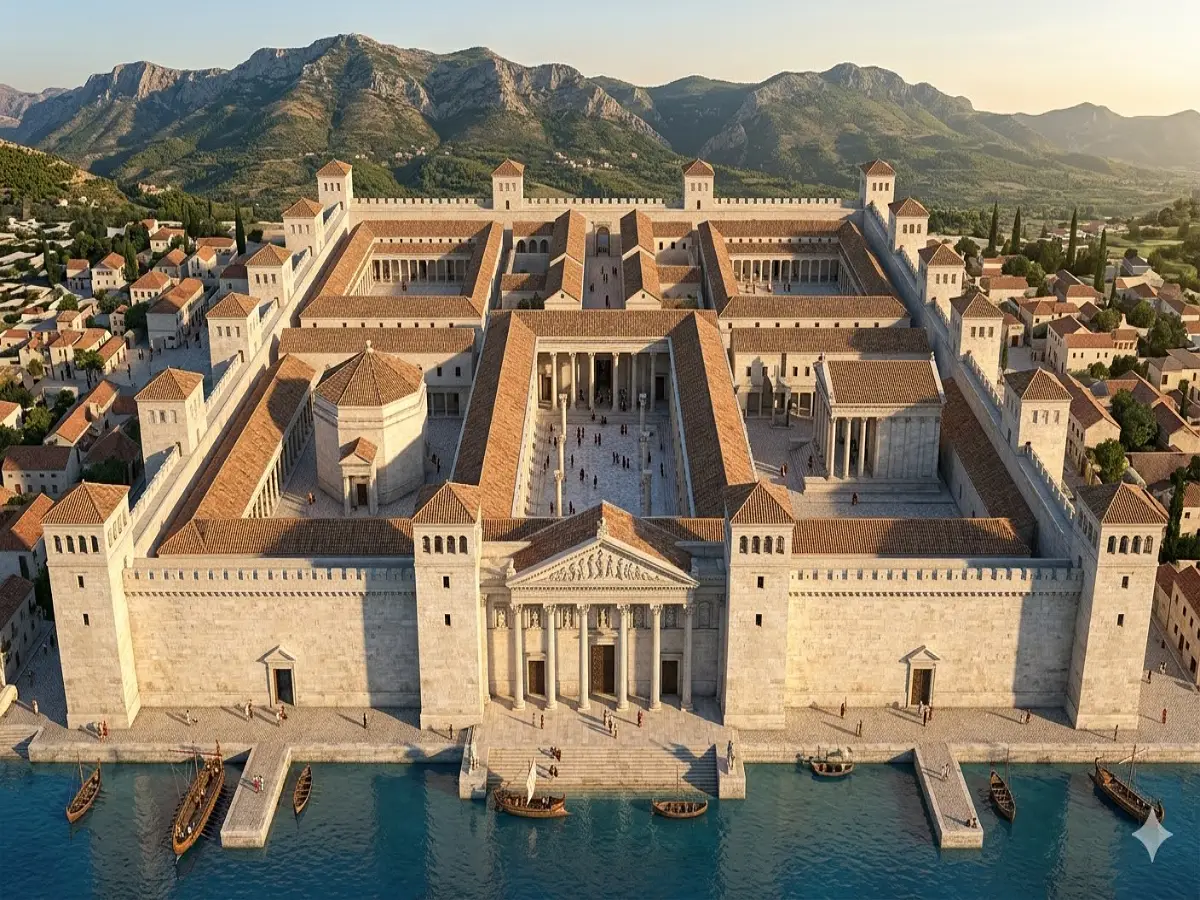
Roman Emperor Diocletian, born nearby in Salona, orders construction of a vast retirement palace on the Adriatic shoreline. Built over 10 years using 200,000 tonnes of stone, the palace covers nearly 40,000 m² and houses 8,000–9,000 people.
615 AD
Refugees flood the palace walls
Following the destruction of nearby Salona by Avar and Slav invasions, thousands of refugees flee into Diocletian's Palace for protection. They transform the imperial chambers into homes, workshops and churches — beginning the city as we know it today.
812–1420
Byzantine, Croatian and Hungarian rule
Split passes between Byzantine, Croatian and Hungarian kingdoms, growing steadily beyond the palace walls. The Romanesque cathedral and baptistery are built. The city develops its own legal statutes and the Statute of Split of 1312 — one of the most important medieval documents in the Adriatic region.
1420–1797
Venetian Republic — 377 years
Split becomes part of the Republic of Venice — the longest single period of rule in the city's history. Venetian Gothic architecture, town squares and palaces are added alongside Roman structures. The Venetian loggia and clock tower are built on the Peristyle. Trade flourishes, and Split becomes a key port on the Adriatic.
1797–1918
Napoleonic and Habsburg era
After Napoleon dissolves Venice, Split passes to France briefly, then to the Austrian Empire in 1813. Under Habsburg rule the city industrialises, expands significantly beyond the old walls, and gains a railway connection. The first Croatian newspaper in Dalmatia is published in Split.
1918–1941
Kingdom of Serbs, Croats and Slovenes
After World War I, Split becomes part of the newly formed Kingdom. The city grows rapidly as an industrial and cultural centre of Dalmatia. The famous sculptor Ivan Meštrović works here extensively, building his gallery and studio on the waterfront.
1941–1945
World War II and resistance
Split is occupied by Italian and then German forces. The city becomes a centre of Partisan resistance. Despite occupation, the palace and old town survive the war largely intact — a remarkable stroke of fortune given the devastation elsewhere in Yugoslavia.
1945–1991
Socialist Yugoslavia
Under Tito's Yugoslavia, Split industrialises rapidly, with the Brodosplit shipyard becoming one of the largest in Europe. The population grows from 40,000 to over 200,000. Tourism begins in earnest in the 1960s and 70s.
1991 — Present
Independent Croatia
Croatia declares independence in 1991. Split plays a vital role during the Homeland War as a logistics hub. The city recovers quickly and becomes one of the Mediterranean's top tourist destinations. In 2013 Croatia joins the EU; in 2023 the Euro is adopted and Croatia joins the Schengen Area.

UNESCO World Heritage — 1979

Diocletian's Palace and the medieval historic core of Split were inscribed as a UNESCO World Heritage Site in 1979 — recognised as one of the most complete and best-preserved Roman palace complexes in the world, and unique for being a living, inhabited historic monument.

The Palace

Diocletian's Palace — Architecture & Layout

The palace is simultaneously a Roman fortress, an imperial residence, a military barracks and a living city. Its four gates, two main streets and central peristyle remain the skeleton of Split today.
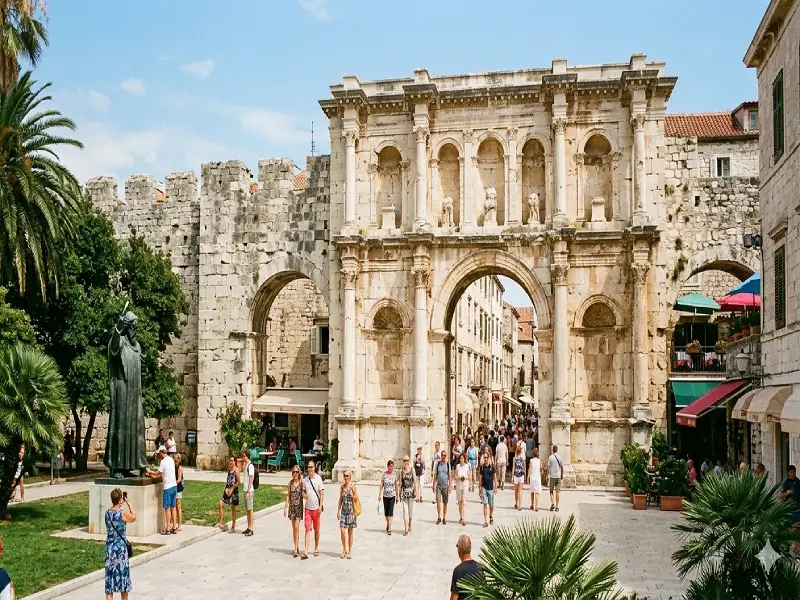
The Golden Gate (Porta Aurea) — the north entrance, most impressive of the four gates
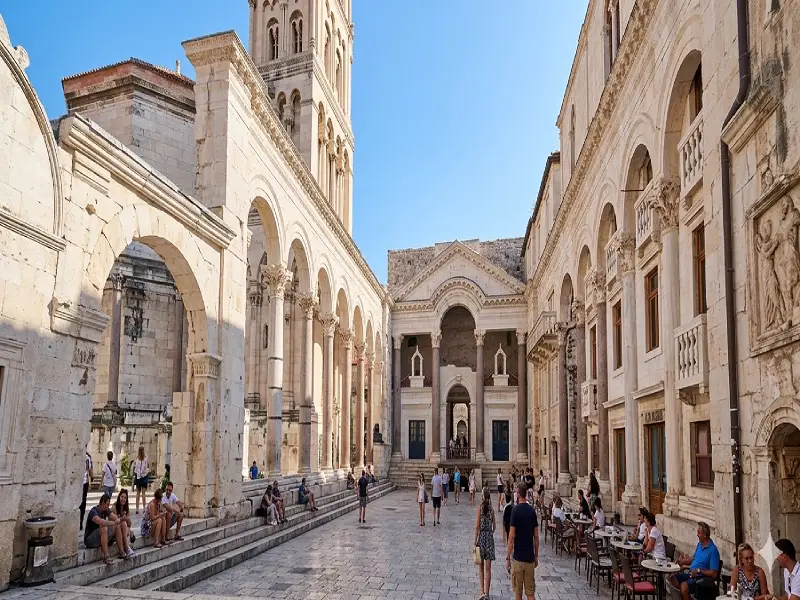
The Peristyle — the main ceremonial square, still the social heart of Split

🔒
Golden Gate
North — most ornate, faces Salona road
🚪
Silver Gate
East — leads to the daily market
Iron Gate
West — leads to medieval town square
🌊
Bronze Gate
South — sea entrance, now opens to Riva